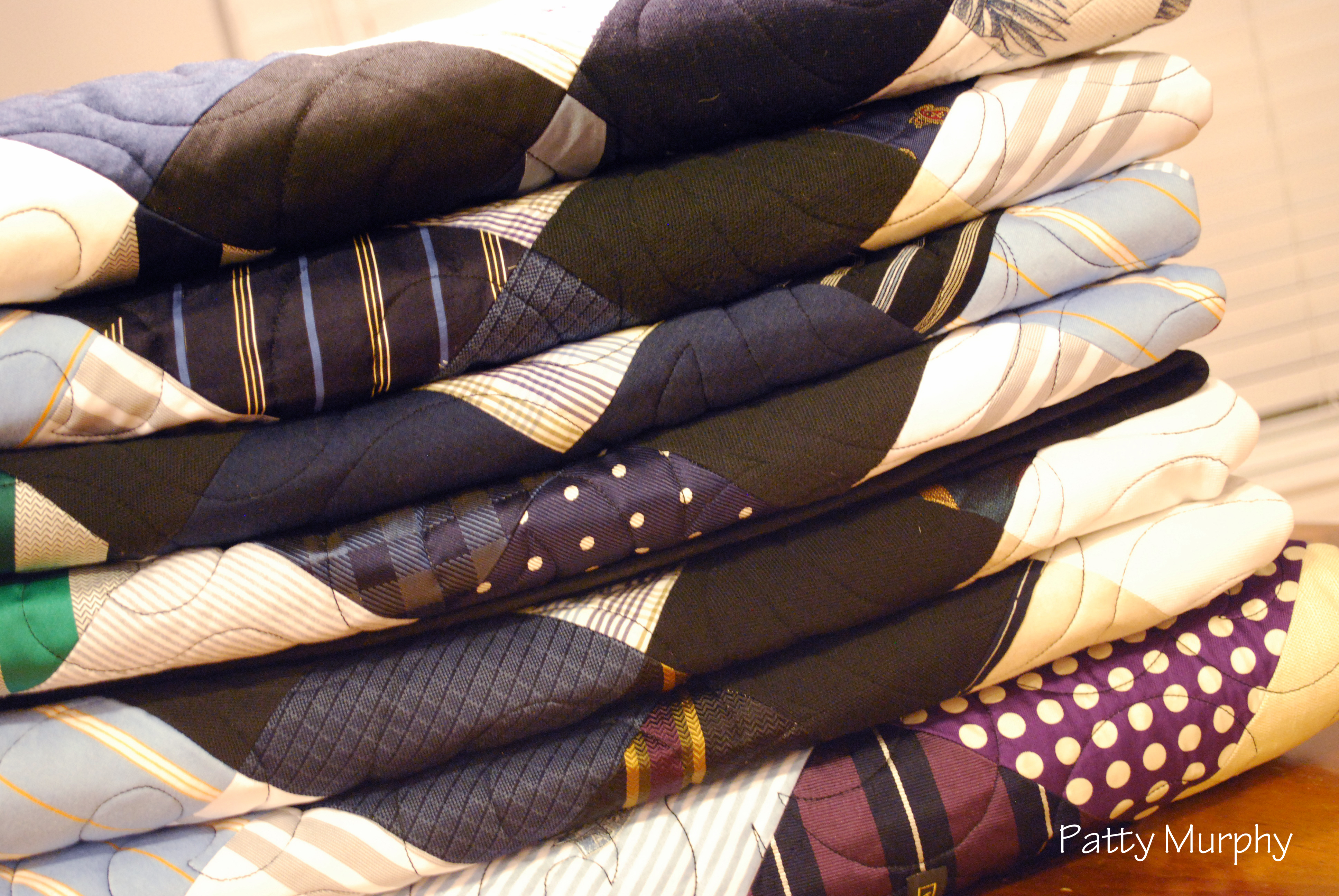
Oh, Patty they are stupendous and beautiful and awesome.
MARSHA
Every great once in a while I make commissioned pieces and more often than not, those commissions involve using clothes, ties or other textiles from someone who passed away.
It’s an honor and a privilege to be trusted to create a keepsake for people using treasured items but I’d be remiss not to share that it can also be a little nerve wracking! There’s a finite amount of material so it’s crucial that I pay attention and there is little to no room for error.
Recently I was asked to make two pillows using neck ties. Fun fact: all the ties had fish on them! Love it. I mean, could they BE any cuter?!
Originally I wanted to have pieces from the red and blue ties in each pillow but the pillows looked like an American flag and lacked any umph. I sat on them a while the decided to pivot.
I made one red pillow and one blue pillow. I used neutral fabrics for the Flying Geese backgrounds so the ties would shine.
The ties were all silk or a silk blend and were so easy to work with. I ironed a piece of lightweight fusible interfacing on the back of each tie before cutting out the pieces. Each 18” pillow has an invisible zipper along the bottom – a dainty closure that won’t distract from the pillow.
Fun fact: I used not one, not two but FOUR (yes, four) feet for this zipper.
I added a strip of fabric to the bottom of each pillow panel and sewed the zipper onto that. The seam allowance for the zipper is larger than the seam allowance for the front and back pillow covers and I didn’t want to encroach on the pillow design. I pinked the excess fabric to minimize bulk.
Leftover material from the ties, along with a strip of a coordinating red and blue Asian fabric, rounded out each back to create the backs
I’m just in love with these! They highlight the ties but hold their own as keepsakes for adult children who can appreciate them.
When I emailed my client that the pillows were finished she replied saying Oh, Patty they are stupendous and beautiful and awesome.
That’s the best thing Marsha could say to me and I’m so glad she likes them.
I love how quilt patterns can create an entirely different feel based on fabrics. Take Persephone Awaits. The original quilt is crisp and modern, made from a collection of ombré fabrics. The second version was made using a collection of blue, white, grey and cream prints. Both beautiful, but they definitely have different feels.
Diamonds can be tricky because of the bias but if you don’t pay attention you can make a mistake. Cue the size. When I laid this quilt on my design wall I didn’t catch that the quilt was a rectangle going the wrong way, i.e. wider than tall. See also: diamonds can be visually deceptive. Once I pieced the quilt I realized that I had to cut the top down to a square because of my mistake. That’s fine. The quilt is still plenty big to cover a lap but that did leave me with the conundrum of what to make with the scraps because I had a different set of leftovers than the original.
And THAT is why I love Zero Waste Quilting. For this quilt I had the same basic shapes leftover but more of them meant I could play to see what I could create.
Like the original leftovers, I used the half-rectangle triangles to create a small wallhanging. I played with the color to create dimension in the blocks. You can see the similarities and see how different the quilts look, too! The original is on the left and the new version is on the right.
And the leftovers I used to make the pillow (see photo above) and crochet case in the original Persephone? They became a cool quilt in this version – mostly because I had extra parts from all the trimming.
Zero Waste Quilting challenges you to work within a set of constraints to use what you have. I just love working in this manner. It takes me back to the roots of quilting because I’m working with a finite amount of leftovers and it forces me to get creative. I love what I make and I love that I’m not buying more fabric to make the additional projects.
Now to figure out what to do with the rest of those leftovers. Squee!
I’m embarrassed that it’s taken me as long as it has to get these patterns into the world. Somewhere between life life-ing (kids, book, travel, whatnot) the pattern writing got a little lost but I am happy to say that I am finally ready to share it with the world. Say what!? Patterns? Yep. I said patterns!
Zero Waste Quilting Comes to Life
What does that mean for you?
I am happy to share that I am now offering patterns BY THE BUNDLE meaning you have the ability to buy the patterns individually or as a bundle. You get the quilt pattern and additional patterns to use your scraps. Zero Waste Quilting in action and I am thrilled about it! You can buy the Persephone bundle here.
Let’s Take It From the Top
Persephone is a quilt I made using 16 fat quarters back in November 2023. That pattern has been out for some time and the Zero Waste quilts and projects from the leftovers have been pieced but the patterns? Boy howdy have they been woefully MIA. No longer, though! And I am so excited about that.
First Things First – The Clio Quilt and Clio Pillow
The first pattern I created from the leftovers was Clio. The Clio quilt was made using the leftover Half-Rectangle Triangles from cutting the center diamonds for Persephone. The Clio pillow is made using the leftover bordered diamonds that I cut off of Persephone when the quilt was squared. Genius, right? I mean, what else are you going to do with those shapes? The Clio Quilt and Clio Pillow pattern are available here.
It’s Okay to Fail
Before I landed on the pillow and crochet case (not pictured), though, I had to take a creative journey. When you challenge yourself to work in a Zero Waste capacity you work within a set of constraints based on the material you have leftover once a quilt has been cut. The leftover shapes and quantities force you to get creative to figure out how to best use what remains on your cutting board. Experimenting and sometimes failure are crucial to exploring all possible options. Remember it is okay if your design doesn’t come out the way you wanted the first time around.
Take the Clio pillow. I did experiment with making it into a hexagonal pillow but, honestly, I hated it so I went back to the cutting board and a pillow and crochet case were born. Manipulating the triangle shapes I had leftover and cutting them in a way that allowed me to create the pillow and crochet case was a brilliant way to use an odd assortment of triangle pieces. If I hadn’t experimented and failed I may not have gotten there. Don’t be afraid to experiment!
I used an invisible zipper on the pillow but you can use a traditional zipper or any other method of closing that you’d prefer – buttons, tabs, whatever you’d like!
The Crochet Case
I’m calling this a Crochet Case because I made it for my sister (who crochets) but this could easily be a carrying case for crayons, pens, pencils, or any other tools that fit.
I didn’t have an even number of triangles to make another row on the pillow so I decided to whip up this case using the last few leftover pieces I had. I used large scraps for the lining and pockets. The Crochet Case came together quickly. You can find the free pattern here.
Mikro Quilt
Mikro is, perhaps, an unexpected favorite quilt. I had a lot of strips leftover from the borders of the diamonds and what better do make with leftover strips than to make a Log Cabin. The strips were all cut the same width so it’s like they were begging me to make a Log Cabin. It’s a perennial favorite of quilters. It’s easy, versatile and fun, and for a little added flair I inserted scraps into strips to give some movement and use the tiniest leftover pieces.
Notice how the pieces inset into the strips are different widths? It’s okay to be perfectly imperfect. This adds movement to the quilt.
I set the blocks on point and used a bold floral between the squares. I’m beyond thrilled with how this quilt finished. You can find the pattern here.
Composition Notebook Cover
If you’ve followed me for a while you know that one of my favorite gifts to make is this composition notebook cover. In fact, it’s a free pattern here. Have a leftover fat quarter? Make a cover? Need a quick teacher gift? Make a cover. And in this case, have some random scraps sitting around? Make a cover.
Basically, if you can take leftover fabric and make a rectangle: you can make this. The instructions explain how to make the cover using one piece of fabric for the cover and how to make fabric to make a unique cover of your own.
It’s In The Bag
As if the Composition Notebook Cover wasn’t cute enough I have to go and share this bag with you. Another free pattern on my website.
When you create in a Zero Waste manner you often end up with a few rogue scraps. In this case I had a few rectangles that were SCREAMING for me to make them into a drawstring bag. The result? An adorable, little bag. Yes, please! Find the bag pattern here.
Radioactive
Cute name, right? The hexagons remind me of a radioactive symbol and I couldn’t think of a better name so here we are.
Now, I have thoughts on this quilt. It’s cute in its own weird way. The fact is when you get down to all the itty bitty scraps you might land somewhere unexpected.
Originally I thought about making this into a small hexagon only quilt but it didn’t come together in a manner that pleased me. That’s when I decided to separate each hexagon and put it into a square. Et voila!
Is this my favorite quilt ever? No but it’s PERFECT for practicing free motion quilting. Say what? Lemonade, my friends.
Not all quilts need to be show stoppers and I think it’s okay to make a meh quilt then use it to practice. The reason is: you won’t be worried about messing up the top. There is absolute beauty in that so yeah. Make a meh quilt and quilt it for practice. It’s a win win in my opinion. And I don’t know about you but I always need a baby quilt so this is perfect quilt to set aside for just that occasion. Find the free pattern here.
Scrunchie
Do you know how difficult it is to take a photo of a scrunchie in your own hair? It’s hard, y’all. But I did it!
I had one strip of fabric remaining and for the life of me I could NOT figure out what to make with it. Enter the scrunchie, and maybe cue Carrie Bradshaw and the scrunchie episode (season 6, episode 4 in case you’re wondering).
In all honesty, scrunchies have been back for a while so I thought it was time to take make one. It was so quick to make and there was NO hand sewing. None. Nada. No pulling and tugging and wrangling fabric. Super simple. This one’s a winner!
I’m going to publish a tutorial soon to show you how I make scrunchies so stay tuned!
Looking for a fast and thoughtful gift? Turn a rogue quilt block into a charming mug rug!
When I purchased my sewing machine in 2017, I decided against the embroidery module, thinking I didn’t need it. Fast forward to 2025, and I found myself regretting that decision. Thankfully, I was able to buy the module from my local BERNINA dealer.
Eager to dive in, I couldn’t wait to experiment with some rogue quilt blocks I had stored away.
While doing a bit of research beforehand is always wise, there’s so much to be learned from hands-on mistakes. Here’s what my first attempt with my module taught me:
Use more spray baste than you think you need. This keeps the block from shifting during embroidery. See below how the block shifted?
Consider the block seam allowance when setting up the embroidery on your block. I didn’t do that for the Sawtooth Star and the quilting extends into the seam allowance.
3. Pay close attention to thread starts and stops. I pulled the thread when I began and managed to mess up a small section. Don’t do that. LOL.
4. Embrace imperfection. Even if the embroidery isn’t flawless, there’s always a way to turn it into something fun.
Enter the mug rugs.
I needed end-of-year gifts for a few teachers and thought these embroidered blocks would make perfect mug rugs. To conceal a few mistakes, I cut the rugs into circles and finished them with leftover bias binding.
I began by marking the center of each block and marking the center of my template. I put the template over the block and marked the edge with chalk.
I trimmed the block the attached scrap bias binding to each mug rug.
Paired with a mug and a gift card to a local coffee shop, the result was a simple yet heartfelt success!
I met Julia several years ago and I jumped at the chance when she reached out to ask if I’d review her new book, Patchwork Luxe. I’ve made many quilts using neckties over the years and was eager to see (read?) if my approach to working with silks differed from hers.
Julia’s book is all about using repurposed silk ties, saris and kimonos. It’s an excellent guide on how to source and work with existing materials instead of buying new fabric to make luxurious quilts. The level of information in this book exceeded my expectations. Julia fills 126 pages with so much detail that confident beginning quilters can tackle projects simply by following her directions.
Overview
One of the things I love about this book is that Julia teaches you about silk. Julia smartly assumes that not everyone has sewn with silk so she gives you a history of the substrate sharing not only how it’s made but the different types of silk, different weaves and lustres of silk and she teaches you how to distinguish silk from synthetics and tells you why it’s important.
The book goes on to share how you can easily combine different substrates as well as the best backing, batting and binding choices. Julia shares the best way to clean silk quilts, too! Additionally there are several pages devoted to what she calls the 4 S’s of working with silk (seam allowance, stabilizers, support, starch) before diving into different techniques of working with silk.
Julia shares techniques to sew your silks that include traditional piecing, crazy piecing, fabric foundations and several ways to appliqué, giving you an assortment of ways to piece your silks so you can confidently dive into any project and be assured it’s successful.
The Importance of it All
I’m somewhat of a traditionalist when it comes to my piecing. In fact, many of you know that my first book, Piecing Makeover, was all about how to fine tune your patchwork so a book that focuses on the foundational elements to work with silk was right up my alley.
Patchwork Luxe will set you up for success sewing with silk fabric. You’ll gain a deeper understanding of the fabrics (crepe de chine vs raw silk vs silk satin, etc) and all of the information provides a strong base from which you can build. If you know and understand the properties of the fabric you are using, you’ll have an easier time sewing with them (ie how to successfully make a quilt using denim and silk).
Final Thoughts
I think this book is an excellent addition to any quilters library. I know many of us are asked to make memory quilts and having quick access to this arsenal of information will only benefit you, especially if sewing with silk is new for you. And if you sew with repurposed or upcycled materials, the information contained in this book will only help your practice become more successful.
Silk Quilts in Real Life
Much of what Julia suggests in her book is how I’ve tackled sewing with silks over the years; BUT I’d be remiss not to say that I learned a lot! I’m so glad I’ll have the tools in my toolbox to tackle more complicated quilts with silk in the future.
Here are a few examples of quilts I’ve made using silks. If I can do it, you can, too!
I’ve been making these Composition Notebook covers for years. They are quick and easy, and you only need a little bit of fabric plus some trim to make one. These Composition Notebook covers make fantastic gifts for teachers, artists, anyone!
The Composition Notebook cover pattern available as a free download in my shop.
Mix It Up
One of the things I love about these notebook covers is that you can mix and match fabrics for your cover, pocket, lining, pencil holder – anything! It’s a great way to use leftover pieces from a quilt or any other project.
Here are examples of Composition Notebook covers with one piece of fabric for the cover and different lining, interior flap and pencil pocket fabrics:
First Things First. The Cover.
If you are going to take a zero waste approach and build out the cover from scraps, know this:
You can do whatever you want – use leftover blocks, strip pieces together, use embellishments – as long as the unfinished cover piece measures 10 1/2’’ x 16’’.
This Composition Notebook cover was made with leftover strips from Persephone Awaits. I used an assortment of strips that each measured 7’’ wide long by assorted heights. I sewed them together to create a 7’’ x 10 1/2’’ piece of fabric before sewing a 9 1/4’’ x 10 1/2’’ piece of fabric to have a 10 1/2’’ x 16’’ unfinished cover.
Sadly, I didn’t take photos of this as I made this cover.
Challenging Myself, Going Further
I wanted to challenge myself for this post and spent some time thinking about what I could do with leftover fabric in my studio. I knew I wanted to share the Composition Notebook cover pattern with you and I knew I wanted to take it up a notch. But how?
As I stared at my shelves, I saw a soft pink batik that I had used on the back of a quilt years ago. The quilt finished around 60’’ wide meaning I had a 10’’ x some length of fabric remaining. I never quite know what to do with these long, skinny pieces I have after a quilt has been quilted, so they either become a quilt sleeve or they sit on my shelf. That’s when it occurred to me! Embellish with thread!
No Measurements, No Problem!
I’m going to share how I put this together with general measurements because the big takeaway is that you can do this with any size scraps you have to make a 10 1/2’’ x 16’’ Composition Notebook cover. My scraps are most likely not the same size as yours. Just keep adding fabric or adjust the measurements until you get the size you need.
That said, the top piece of my composition notebook was about 6’’ x 22’’ and the bottom piece was about 10’’ x 22’’. Make sure you cut the pieces WIDER than you think because you can cut them down later.
Dress You Up With My Stitches
Now that I had chosen the fabric, I needed to figure out how to make it shine. I sat on that for a bit then, seeking inspiration, I turned to the Big Book of Feet and the Big Book of Stitches.
I recommend these books for your sewing and quilting arsenal. They are invaluable.
The Big Book of Feet shows you all the quilt feet BERNINA offers and how to use them. The Big Book of Stitches gives you tons of inspiration and shares, among other things, how to manipulate the stitches on your machine to create one of a kind creations.
The short version is that I found the inspiration I needed.
Fagoting Stitch, Part 1
I decided to attach the pieces using a fagoting stitch. I pressed each piece 2’’ to the back to create a fold along the length of my scraps resulting in 4’’ x 22’’ and 8’’ x 22’’ pieces.
To create this stitch, use the #7 foot. Set your machine for a 5.5 width zig zag stitch, 0.3 stitch length and an upper thread tension of 0.75-1.0 (you may need to play around with the tension).
I placed a piece of lightweight stabilizer behind the fabric for some added stability. The two pieces of fabric should butt next to one another when you are sewing but you can see the stabilizer peeking through here before stitching.
Part 2
I used my 20C foot to create the heirloom look. I adjusted my upper thread tension back to normal and set the #6 triple stitch with a 3.5 stitch length. Next I gently pulled the fabric (and thus, the stitches) apart to open the space between the two pieces.
When I sewed, the triple stitch gathered every few threads in the open space between the fabric to create a hemstitch look.
Creating the hemstitch.
Then I picked a decorative stitch I liked to sew on either side of the fagoting.
Part 3
I’m a believer that it’s not done until it’s overdone so I decided to add some ribbon to each side of the decorative stitching.
I attached the right seam guide to my presser foot so I could accurately sew down the ribbon.
I trimmed the cover to 10 1/2’ x 16’’.
Put It All Together
Materials Needed 1/2 yard fabric, 3/4 yard if fussy cutting 1/2 yard ribbon, or other trim for tying thread to match
Cutting Instructions: cut (2) 16” x 10 1/2” pieces*, one for the outside cover and another for the lining
*IF YOU USED THE ZERO WASTE METHOD, BUILD OUT YOUR COVER PIECE TO 10 1/2’’ X 16’’ and cut one rectangle 10 12/’’ x 16’’ for the lining
cut (2) 10 1/2” x 5” pieces for the inside flaps cut (1) 1 1/2” x 6” piece for the pen/pencil holder cut (2) 8” pieces of ribbon or trim for tying -or- cut (2) 2’’ pieces for pencil closure
Assembly Instructions:
Make the Inside Flaps
1. Place the two 10 1/2’’ x 5’’ inside flap pieces on a table, wrong side up. 2. Fold the right side of the left flap to the back side of the fabric by 1/4’’ along one 10 1/2’’ side. Press. Repeat with a 3/8’’ fold. Press. Straight stitch along the edge to keep the seam in place. Set aside. 3. Fold the left side of the right flap to the back side of the fabric by 1/4’’ along one 10 1/2’’ side. Press. Repeat with a 3/8’’ fold. Press. Straight stitch along the edge to keep the seam in place. Set aside.
I used the seam guide and a 1/4’’ seam to secure the flap edges but you could use a contrasting decorative stitch, handstitches or an edgestitch to secure the seam.
Make the Pencil Holder Option 1
1. Fold the sides of the 1 1/2’’ x 6’’ pencil holder back by 1/4’’ on ALL sides, bringing the front of the fabric to the back. Press. 2. Sew the pencil holder to the left flap taking care to center it.
Option 2 1. Cut two rectangles 2’’ x 6’’. Place them right sides together and sew 1/4’’ around the edges, leaving a 2’’ opening along one side. 2. Clip corners, turn right side out, and press. 3. Sew the pencil holder to the left flap taking care to center it.
Option 3
1. Cut 2 pieces of ribbon 2’’ long. Set aside.
Adding the Ribbon Mark 5 1/4’’ up each side of the Composition Notebook holder.
Option 1
1. If you plan to use a small ribbon closure instead of or in addition to the interior pencil holder, fold the ribbon in half. 2. Place the ribbon on the right side on top of the center mark and place the ribbon on the left side below the center mark.
Option 2
1. If you plan to use ribbons to tie the notebook closed, place one edge of the 8’’ long ribbon at the 5 1/4’’ mark. The ribbon will across into the center of the cover. Baste. 2. Repeat for other side. Place the inside flap pieces right side together with your cover piece. The finished edges of the flaps will be facing the center. Sew a very scant 1/4” from the top to the bottom of the outside edges on the left and right sides.
Putting It Together
1. Place the 16” x 10 1/2” piece you want to use for the FRONT cover FACE UP on a table, cutting mat, etc. 2. Place the flap pieces right side together with your cover piece. The finished edges of the flaps will be facing the center. Sew a very scant 1/4” from the top to the bottom of the outside edges on the left and right sides.
3. OPTIONAL: If you would like to add a bookmark to your Composition Notebook holder, cut a piece of ribbon or trim approximately 12’’ long. Tie one end of the ribbon in a knot and place one end of the ribbon at the top of the Composition Notebook Holder. Pin in place.
4. Place the lining piece face down on top of the assembly from step 2. Sew 1/4” around all edges EXCEPT for a 2” gap along one flap. 5. Turn right side out, press, and put over Composition Notebook. Enjoy!
My book, Zero Waste Quilting, is a simple concept based on the idea that we can make a quilt then use all our fabric to create smaller projects. We create a capsule collection, of sorts, and what happens is we eliminate overflowing scrap piles because we have beginning to end use of goods.
When working in this capacity not only do we return to the roots of quilting – using every last scrap – but we encourage mindfulness with our consumption and we foster our creativity.
My Thanks to You
Expressing gratitude to the artists and companies that have supported my new book feels almost impossible to put into words. Saying that I am humbled doesn’t seem to capture the depth of my feelings. The amount of (unpaid) work they have done for someone else—for me—is truly staggering. I’m overwhelmed by the outpouring of support: from those who participated in the book tour, to those who bought (or won) a copy, to those who cheered me on every step of the way. From the bottom of my heart, thank you.
The Cheerleaders
Thank you to the following companies and artists who supported me. Their reviews are linked here so you can see what everyone had to say.
The quilting industry continues to amaze me in the most wonderful ways. This book tour has been a powerful reminder of how fortunate I am to be part of such an inclusive, welcoming, and supportive community. It’s a combination of luck, a great deal of hard work, and the privilege of finding my people. I am deeply grateful for these connections.
A Long and Winding Road
This book has been years in the making. The initial spark of an idea came when I pitched Piecing Makeover back in 2015, but it took nearly a decade for that spark to ignite and evolve into Zero Waste Quilting. From the time I officially pitched this book to the moment I held it in my hands, almost two years passed. I’ve said it before, but it bears repeating: I am incredibly proud of this book—of the ideas within it and of all the projects it contains.
This book is a reminder that sometimes we need the time to sit on ideas we have – that giving ourselves the time and grace to allow something, anything to come together will always result in an object of beauty that’s not only completely developed but fully encompasses the message we want to share.
Zero Waste In Action
HollyAnne Knight at String and Story took it all a step further and used her scraps to create a Lone Star following the pattern in my book. I’ve shared her quilt below and you can read about the journey to make it here.
I love how HollyAnne created her Lone Star. She separated her scraps by hue and and created a rainbow. Each strip of the Lone Star is one color vs a mish-mosh of scraps like my quilt. I really like how the center came together. It reads like a more traditional Lone Star but the colors radiate out in strips. Very cool, HollyAnne. Very cool.
I hope you love this book as much as I do. I hope it encourages you to be mindful of your consumption and inspires you to look at fabric and scraps with new light. I have no doubt that you’ll be amazed at the beauty you can create with what you have.
Y’all! I am so excited that my book, Zero Waste Quilting, will be in the world THIS MONDAY!
What is Zero Waste Quilting?
My third book, Zero Waste Quilting, will be out in November. The concept behind Zero Waste Quilting is that every scrap of fabric from a quilt is used to make a quilt and subsequent projects. Thinking even bigger: it’s a redesign of how we use scraps. Traditionally we make quilts and scraps land in the garbage, a destash, endless piles in our sewing spaces, or elsewhere. With Zero Waste Quilting all the leftover fabric from quilts is transformed into useful secondary projects.
Why is Zero Waste Quilting Important?
When we think in larger terms about our environmental footprint specifically with regard to textiles, we need to acknowledge that textiles are a huge pollutant and contributor to global warming. And when we think about what resources we have as quilters, our options have traditionally been up-cycled materials, a limited (but growing!) selection of GOTS, OEKO-Tex or digitally printed materials.
All three of those options are fabulous and we should fully utilize and take advantage of them when we can. I recognize that availability and cost factor into the conversation When those options aren’t actually an option or if you are like me and up-cycled materials aren’t really my medium of choice, then what happens? How can I continue to create while being a better steward to the planet? Enter Zero Waste Quilting. The concept introduces a middle ground so we can stretch the life of the materials we use. Better for our wallets and better for the planet. Plus who doesn’t need a cute gift from time to time? This way you can grab and go. There’s a bonus in that, as well!
How Does Zero Waste Quilting Work?
The reason Zero Waste Quilting is important is because we can take steps to minimize our environmental impact through craft. We all have scraps. We all have piles in overflowing bins and often we don’t know what to do with them. At a certain point, scraps can become overwhelming. What to do with all those mis-cut pieces, random cuts or fabric that has otherwise been cast aside.
Zero Waste Quilting takes the hassle out of how to handle your scraps. In my book, and now this pattern, you are given supplemental projects to make, meaning the frustration and overwhelm of figuring out how to use your scraps is eliminated. Additionally, you gain some freedom in that each project is fluid so you can make an item slightly larger or smaller to allow for mis-cuts or extra yardage you may have. For example: does it matter if your scrunchie begins with a 3” vs a 4” strip? Nope! You can make it with either size AND you still get a cute scrunchie.
Now, I know what you’re saying: I know how to use the scraps or I love having scraps around but not everyone does. In fact, at a guild meeting a few months ago a member offered that she threw the scraps away after a quilt was made because she didn’t want to hassle with them. And I am not here to throw shade on anyone but people toss material if they can’t figure out how to use it. In addition to being wasteful, it’s not good for the planet (or our wallets) so this concept helps us minimize our footprint just a little by using all the fabric. Beginning to end use of goods.
Zero Waste In Action
To demonstrate how this works, below is my quilt, Misunderstood. It is one of the four main projects in my book. Below the quilt I share the smaller projects I created using all the remaining scraps from the main quilt.
Where Can You Get a Copy?
You can buy a signed copy from me, you can ask your LQS to buy some copies for their shop, major retailers have it OR you can try to win a copy during the virtual book tour!
What’s a Virtual Book Tour?
A virtual book tour introduces my book to you via an amazing line up of artists and companies. Each day participants will share a review of my book. They’ll tell you what they like, why they like it and/or highlight some projects. It’s a great way to engage and ask questions from unbiased sources, too, because I am completely biased about my work. LOL.
During the tour, you may follow artists, companies and me to win a chance to receive a free e-book or a free physical copy of my new book. Pretty fabulous, right?
Here’s the List of Tour Participants
My book tour runs Tuesday, December 3 through Thursday, December 19th! That’s A LOT of opportunities to win a copy. Here’s the line up:
Tuesday, Dec. 3rd – Book Tour announcement on the C&T Blog Wednesday, Dec. 4th – Pat Sloan Thursday, Dec. 5th – Raylee at Sunflower Stitcheries Friday, Dec. 6th – Maddie Kertay Monday, Dec. 9th – Emma Jean Jansen Tuesday, Dec. 10th – Mary Quilts Wednesday, Dec. 11th – Teri Lucas of TerifiCreations/ The Book Report Thursday, Dec. 12th – Bernina Friday, Dec. 13th – Jennifer Paganelli Monday, Dec. 16th – HollyAnne Knight/String and Story Tuesday, Dec. 17th– Jennifer Sampou Wednesday, Dec. 18th – Aurifil Thursday, Dec. 19th: Book Tour concluding with me getting verklempt
I Want to Hear From You
If you buy (or win!) a copy of my book, I’d love to hear from you. Let me know what you think and, as always, reach out with questions!
My third book, Zero Waste Quilting, will be out in November. The concept behind Zero Waste Quilting is that every scrap of fabric from a quilt is used to make a quilt and subsequent projects. Thinking even bigger: it’s a redesign of how we use scraps. Traditionally we make quilts and scraps land in the garbage, a destash, endless piles in our sewing spaces, or elsewhere. With Zero Waste Quilting all the leftover fabric from quilts is transformed into useful secondary projects.
Why is Zero Waste Quilting Important?
When we think in larger terms about our environmental footprint specifically with regard to textiles, we need to acknowledge that textiles are a huge pollutant and contributor to global warming. And when we think about what resources we have as quilters, our options have traditionally been up-cycled materials, a limited (but growing!) selection of GOTS, OEKO-Tex or digitally printed materials.
All three of those options are fabulous and we should fully utilize and take advantage of them when we can. I recognize that availability and cost factor into the conversation When those options aren’t actually an option or if you are like me and up-cycled materials aren’t really my medium of choice, then what happens? How can I continue to create while being a better steward to the planet? Enter Zero Waste Quilting. The concept introduces a middle ground so we can stretch the life of the materials we use. Better for our wallets and better for the planet. Plus who doesn’t need a cute gift from time to time? This way you can grab and go. There’s a bonus in that, as well!
How Does Zero Waste Quilting Work?
The reason Zero Waste Quilting is important is because we can take steps to minimize our environmental impact through craft. We all have scraps. We all have piles in overflowing bins and often we don’t know what to do with them. At a certain point, scraps can become overwhelming. What to do with all those mis-cut pieces, random cuts or fabric that has otherwise been cast aside.
Zero Waste Quilting takes the hassle out of how to handle your scraps. In my book, and now this pattern, you are given supplemental projects to make, meaning the frustration and overwhelm of figuring out how to use your scraps is eliminated. Additionally, you gain some freedom in that each project is fluid so you can make an item slightly larger or smaller to allow for mis-cuts or extra yardage you may have. For example: does it matter if your scrunchie begins with a 3” vs a 4” strip? Nope! You can make it with either size AND you still get a cute scrunchie.
Now, I know what you’re saying: I know how to use the scraps or I love having scraps around but not everyone does. In fact, at a guild meeting a few months ago a member offered that she threw the scraps away after a quilt was made because she didn’t want to hassle with them. And I am not here to throw shade on anyone but people toss material if they can’t figure out how to use it. In addition to being wasteful, it’s not good for the planet (or our wallets) so this concept helps us minimize our footprint just a little by using all the fabric. Beginning to end use of goods.
Progression of Projects
Persephone Awaits
This is the first quilt in this series. I began with half-yard cuts of 15 different fabrics to make Persephone Awaits.
Small Yet-to-be-Named Quilt and Pillow
The second quilt used leftover half-rectangle triangles to create this darling wall hanging. The pillow was created from the off-cuts from the diamonds. I created a pillow insert with the smallest scraps (less than 1”), thread and batting for the pillow. The pillow has an invisible zipper closure.
Wonky Log Cabin
I used the leftover yardage to create strips and inset small, angled off-cuts into them to create this updated Log Cabin quilt. The on-point floral fabric is a Kaffe Fassett that I cut on the bias so all the flowers would be facing the correct direction.
Here’s what actually happened when I was trying to get a photo. Cute but not helpful.
Crochet Hook Holder
I had three pieces remaining after I created my pillow and after some thought, I decided a crochet hook/needle holder would be the perfect project to make. The pieces were the correct size to come together in this small carrying case.
Even Smaller Quilt
The even smaller pieces became hexagons in this small wallhanging.
Composition Notebook
As the pieces whittle down, I’m forced to get even more creative with the projects I make. Working within a set of constraints challenged me creatively and I’m proud of each project in this series. That said, the leftover strips stumped me for a bit before realizing they would make a lovely composition notebook cover. I used some of the leftover floral fabric from the Log Cabin quilt for the back and some scraps I had on hand for the inside.
Tiny Bag
This is seriously one of the cutest bags I’ve ever made. It’s sweet and small and I just love it! The perfect jewelry or small gift pouch E V A H!
Return of the Scrunchie
It took me a while to get on board with the scrunchies are back trend but now I’m fully engaged in it. So much so that I made one using the smallest strip of fabric I had remaining. It’s also worth noting that taking a photo of a scrunchie on one’s own head is a challenge.
So What’s the Takeaway?
The takeaway is that when you make a quilt, challenge yourself by using all the material. If you start with 6 yards of fabric, make your quilt then see what other things you can create with the leftovers. You’ll surprise yourself with what you can come up with and you’ll create a lovely capsule collection of projects to keep on hand for when you need a little something. I promise, it’s worth it!
I was asked by my second mama to make a quilt for a special person in her life. Mama E has known me since I was a baby. Her daughter is my oldest friend – we grew up together, were college roommates, Maid and Matron of Honor – that sorta thing. Chosen family. The kind of family that goes back so far we don’t need to explain things, we just get it. We know the stories, the people, the supporting cast members. There for all the milestones, holidays and more. Our lives have been intertwined for 50 years and, while I could easily go down a rabbit hole about that, I’ll just sum it up to say what a blessing. How lucky am I to have a friend like that in my life? But I digress.
Anyhow, when chosen family reaches out to ask if you’ll make a quilt for a special friend having a baby, you quickly oblige her. The baby is due soon and I was asked to make a quilt using her parents clothing.
Now, I’m not one to take (many? any?) commissioned quilts, especially when working with clothing. T-shirts are one thing but quilts from ties and garments? Such pressure! If there is one mis-cut, I have a big problem. It’s not like I can go to the store and buy more fabric or replace the item. You have to get it right. That pressure is one thing then there’s the pressure to make sure that you make a lovely quilt because quilts made from garments are really emotional objects for the recipient. For good reason, of course, but pressure all around, for certain. And what’s worse? What if they don’t like it?! gah! Even more selfishly, I’d be remiss not to share that I have such limited time sewing that when I do have time to sew I want to work on my work. But when mama E asked I couldn’t (wouldn’t?) say no to her.
So I met mama E one morning for a cup of coffee and she gave me a bag of ties, linens and garments. I began by taking everything apart then got to work. The center of the quilt went through a few iterations; at one point I had some green, blue and orange in there – it was sort of working but I wasn’t really happy with it. I took a step back and realized how to make all the piece come together, and when it all finally came together, the work was fast.
Here’s a little progression.
I ironed Woven Fusible interfacing to each of the ties and garments for stability before I cut them. The linens didn’t need it as they were still in good shape and I didn’t think it was necessary to add the extra weight and bulk to the quilt. Many of the ties were wide enough to cut a larger quantity of squares for the quilts but ties aren’t all the same size, so that posed a minor design challenge – what will fit where? I had to carefully measure and count squares to make sure the design could come together. It was important to me to make sure that each row of squares was created with one tie or other item for continuity instead of mixing and matching. I’m sure on a galloping horse no one would know but I would.
The squares finish at 3” each to make this lovely Trip Around the World quilt and my friend, Cheryl, quilted the top for me using a darling floral pantograph. I made the binding using some grunge I had on my shelf and I picked up the Ruby Star Society backing from String and Story.
I’m really pleased with how this quilt turned out. Taking garments and linens and incorporating them into a quilt that is both visually appealing and makes sense is a challenge but I think this worked out well.